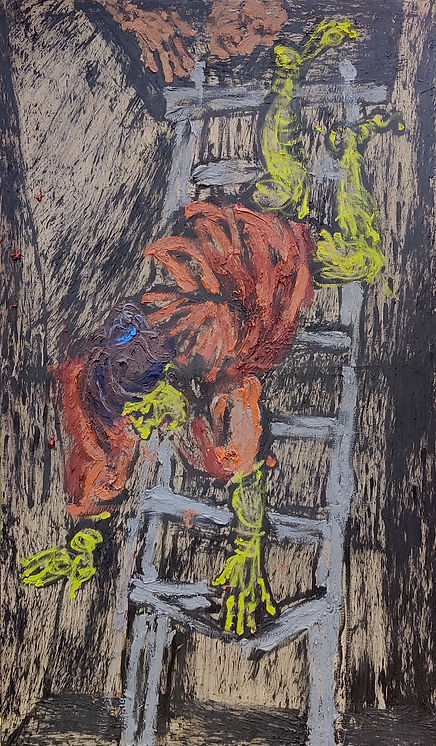
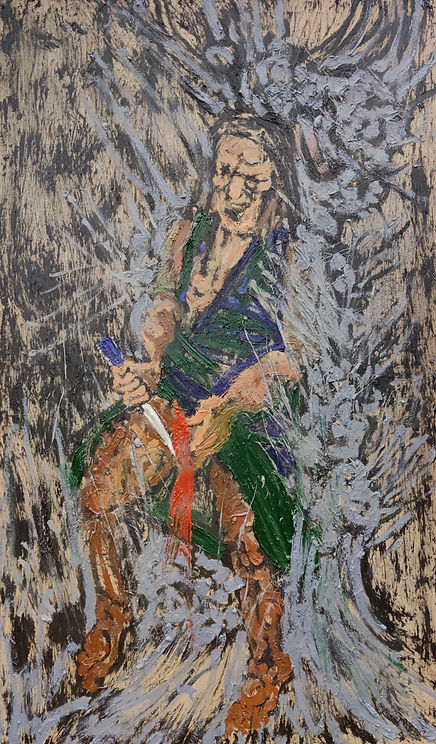
„BESSARABIA“,
oil on canvas, 90x120cm, 2010, Yona Tukuser
The painting is owned by The National Gallery, Sofia
„Two great Bulgarian diasporas existed on the territory of Ukraine: Bessarabia and Tauri. During the two Holodomors from 1921-1923 and from 1932-1933, about 30 000 Bulgarians have died in Tauri. By the beginning of the Second World War the Bulgarians in Bessarabia were within the boundaries of Romania. In the winter of 1946-1947 the Stalinist government organized Holodomor in Bessarabia, when more than 70,000 ethnic Bulgarians have died. As a result of the three Stalinist Holodomors about 100,000 Bulgarians have died in Bessarabia and Tauri.“

„She ate one leg of her child“,
size 135 x 267 cm, oil on canvas, 2023, Yona
On April 30, 2018, in the village of Glavan (Odessa region), Yona spoke with Mutafchi Melania Georgievna (1954).
The daughter of the famine victim said:
She ate her little hand and one leg, it was a tiny child. She died by the evening and we buried her.
My mother used to tell me that during the famine, our neighbor had four children. My mother thought she hadn't seen these kids outside for a long time and decided to go see what was going on. Entering the house, she sees that one girl is sitting by the stove and sucking her hair out of hunger. And the youngest child was lying in the cradle with a leg and a hand eaten by his mother.
Archive: HUNGER-DOHA-01-05-2

„We ate leather shoes and soles“
Yona, 2023
size 136 x 278 cm, oil on canvas

„I gave her a shoe to bake“
Yona, 2022
size 135 x 250 cm, oil on canvas
A neighbor came, brought me clothes that she stripped off from the dead people, and said: "Give me a moccasin and take some clothes." “Get out of here!” I said. "Go away! We ourselves are dying of hunger, what could I give you?". My father felt sorry: "Zina, go inside the room, there are moccasins in the cupboard." "Give her a moccasin, let them roast it." I gave her a moccasin to bake. After roasting them, we'd scrape them well with a knife and crunch them, we'd eat and drink water.

„She ate her husband“
Yona, 2022
size 135 x 250 cm, oil on canvas
„She ate her husband“. We heard that Simontsa ate Simon. A woman slaughtered her husband, boiled him so they could eat.

"A BOY WITH A DEAD HORSE"
Yona, 2022,
size 120 x 400 cm, oil on canvas
"One boy's parents starved to death (1947); and the boy went hungry to the dump; and people have seen him hauling up with a hook the stinking, decaying body of a dead animal. And a man took this child to himself and did not allow him to eat from the dead animal. This child was raised by this person and survived".
Story told by V.I.Tutova (born 1925), Glavan, Ukraine.
April 29, 2018.
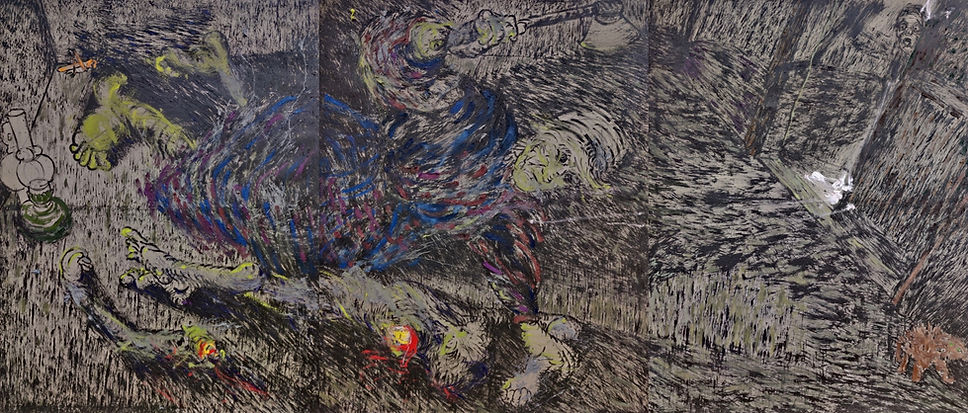
"Mother killed brother",
oil on canvas, 220 x 480 cm, 2023, Yona
On April 29, 2018, in the village of Glavan (Odessa region), Yona spoke with Vasilisa Ivanovna Tutova (b. 1925).
The famine victim said:
"I know of a woman named Ivantsa who ate her child. She started to eat and the older son saw her. She immediately ran away from home and was speechless from terror and fear. His mother went mad from starvation and died."
Archive: HUNGER-DOHA-01-04

„To save the elder daughter from starvation, the mother slaughtered the younger“,
220 x 160 cm, 2023, Yona Tukuser
Buziyan Elena Grigorievna (b. 1938) in the village of Ostrivne (Odessa region) recalls: "I remember my father's story that in one of the nearby villages, in order to save her older daughter from starvation, a woman slaughtered and cooked her younger daughter. The eldest daughter saw this, was frightened and ran away and never returned to her mother."
Pelivan, K. “The Famine of 1946–1947 in Southern Bessarabia: Artsiz District of Odesa Oblast.” Page 125. Artsiz, 2008

„Six Peas and a Shoe for Dinner“,
oil on canvas, 220 x 160 cm, 2023, Yona Tukuser
On May 18, 2018, in the village of Golitsa (Odessa region), Yona spoke with Tatiana Stoyanova (b. 1971). The granddaughter of a famine victim said:
"My father says that during the great famine he was 6 years old and went to the field where they were collecting grain. The foremen would let him take peas he found among the grain. My father spent the whole day sorting the piles of grain and brought six peas home. His mother made soup with those six grains and grass for dinner."
Archive: HUNGER-DOHA-11-02

„Two Sisters Killed the Husband of One of Them and Ate Him“, oil on canvas, 220 x 160 cm, 2023, Yona Tukuser
On May 20, 2018, in the village of Sambatar (Odessa region), Yona spoke with Mikhail Petrovich Ganchev (b. 1929). The famine victim said:
"Our village of Sambatar is very poor because the land here is very bad. About 600 people have died of starvation in the village.
During the famine of 1946, people died in our village. They went and took the wheat from the people by force. We had three big wicker baskets filled with corn cobs, each containing two or three kernels. A man from the town hall came with a cart and three others and took the corn cobs from us and said, "Die!" Do you hear what he says to us? "To die"?! This man is from Sambatar.
In the famine they were selling jelly, but where did they get this pig from? It was human flesh. Jelly made of human flesh. In one cemetery, there was an open common grave where every day they threw 10-15 people who died of starvation. There were people who used to go there and cut human flesh from the dead and make jelly and sell it in the village market. Great starvation, people bought and ate. The man doesn't know what it is, it looks like jelly. And that's how we lived. There are people left alive, as you see me.
There was a house in the next street where two sisters lived and they killed the husband of the one and ate him. Then they died."
Archive: HUNGER-DOHA-12-01

„My aunt ate her two daughters“,
oil on canvas, 220 x 160 cm, 2023, Yona Tukuser
On May 21, 2018, in the village of Golitsa (Odesa region), Yona spoke with Zagorskaya Stefanida Stepanovna (b. 1939). The famine victim said:
“In 1946-47 it was very scary. Hunger. Death. We had nothing to eat. In the war they took what they could. After that, there were publicans in our village who took people's stored grain. My father starved to death in 1947. Our family was starving. My aunt, Belioglo, faced this unimaginable ordeal when her husband starved to death, leaving her without food. She slaughtered her two daughters, and ate their flesh. She even came to our house, knocked on the windows, but we did not dare to open the door to her, as we were afraid that she might eat my mother or me. Then the neighbors would say, "It's a good thing your door was locked, otherwise she would have eaten you!" My mother would answer them: "I'm old, it's better if she eats me, at least she won't touch my child!" She wandered the streets looking for open homes to enter, hoping to find someone to slaughter and eat. Eventually she died.”
Archive: HUNGER-DOHA-11-03

„The raven pecked out his eyes“,
oil on canvas, 220 x 160 cm, 2023, Yona Tukuser
"In 1947, when I was already in the collective farm, I worked in the fields all day. When I would come home in the evening, I would see here and there a dead man lying on the road... and the crows were pecking out their eyes."
Mitev P., Chervenkov N. "Bessarabian Bulgarians for themselves". Sofia, 1996, p. 346.

„Woman eats dead horse“,
oil on canvas, 220 x 160 cm, 2023, Yona Tukuser
On April 29, 2018, in the village of Glavan (Odessa region), Yona spoke with Nastradin Lukeriya Konstantinivna (b. 1922).
The famine victim said:
"Hunger. Hunger. Hunger. Many people died. Half of the village died out.
One woman, during the famine, ate her own child.
We were going to work at Alyaha, and on the road we saw a woman stepping over a dead horse. She bent down, tore off pieces from it, and ate them. During the famine.
And that was not the only case. Another time I was walking and saw a man gnawing at a dead body."
Archive: HUNGER-DOHA-01-03
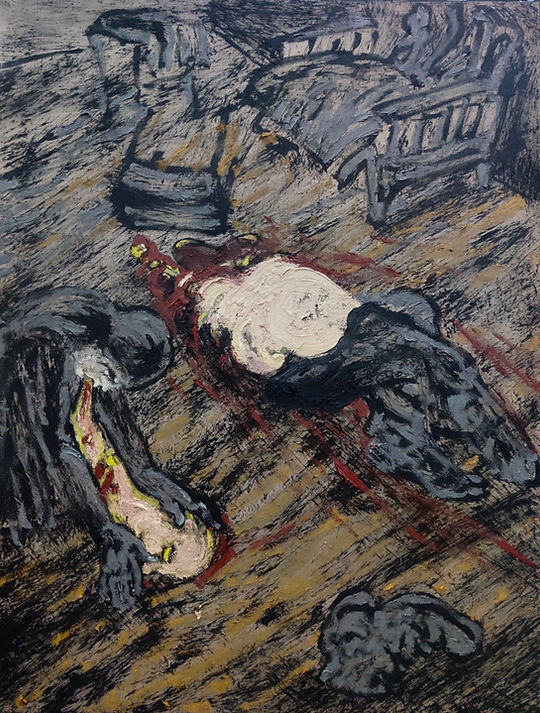
„Bites and Eats“,
oil on canvas, 220 x 160 cm, 2023, Yona
On April 22, 2018, in the village of Kamyanka (Odessa region), Yona spoke with Nastradin Lukeriya Konstantinivna (b. 1922).
The famine victim said:
We were starving. I experienced famine in my childhood, and then after I got married, another great famine began.
In the village, people were dying right on the streets like dogs. Where they died, they were left there. During the famine it was very frightening.
Many people, the so-called “kulaks,” were deported from the village to Siberia, and many of them died on the way.
One family killed their child and ate it.
Everyone is hungry! What can they do?
There is nothing to eat! Besides gnawing and eating.
People were terribly weak.
A man is dead! They bite him! They eat him!
They also ate their child.
Archive: HUNGER-DOHA-03-01

"People ate the bark of trees",
oil on canvas, 220 x 160 cm, 2023, Yona
"Ukraine was the main supplier of grain to Leningrad (now St. Petersburg) and vegetables to Moscow. In 1946-1947 trains of bread were sent to Germany under the slogan: 'To the German people from the Ukrainian people'. Meanwhile, the situation in the Bulgarian villages was dire. Bulgarians were digging frozen potatoes and beetroot, leftovers from the collective farm fields after the harvest, out of the snow. They resorted to eating tree bark, mice and dogs. Diseases such as dystrophy, various forms of poisoning and parasitic typhus spread among the starving due to exhaustion. Many corpses littered the fields as people wandered from village to village in search of sustenance, often perishing along the way. The starving peasants were not allowed to leave Ukraine, nor were they issued passports."
Tatarko Inna. The Famine of 1946-1947 in the Bulgarian Villages of the Izmail Oblast of the USSR. III Danube Scientific Readings. Izmail. 2017, p. 256.