BOOKS ABOUT THE SOVIET MASS FAMINES

Title: "The Holodomor of 1947"
Author: Bilas I.
Place of publication: Ukraine, Kyiv
Year: 1990
Language: Ukrainian
1946-1947

Title: Drought and Famine in Moldova, 1946–1947
Author: B. G. Bomeško
Place of publication: Moldova, Chișinău
Year: 1990
Language: Russian
ISBN 5-376-00846-0
Abstract: Based on an extensive documentary base, much of which is introduced into scholarly research for the first time, this book examines one of the most dramatic episodes in the post-war history of the Moldavian SSR: the drought and famine of 1946–1947.
The author analyzes not only the origins of the tragedy but also the factors that aggravated it, revealing the mistakes, miscalculations, and abuses that occurred during this period. The book presents a picture of the unimaginable human suffering caused by famine, including dystrophy, deaths from starvation and malnutrition, and other consequences of severe food deprivation.
It also describes the scale of the efforts undertaken in the republic to save people from hunger and disease and to overcome the consequences of the drought.
1946-1947

Title: The Famine in the USSR, 1946–1947: Origins and Consequences
Author: V. F. Zima
Place of publication: Russian Federation, Moscow
Year: 1996
Language: Russian
ISBN 5-201-00595-0
Abstract: This monograph is devoted to an important and previously almost unexplored topic. Based on new materials that had previously been inaccessible to researchers, including secret documents from the collections of Soviet party and state archives, letters, eyewitness memoirs, books, and articles published on related aspects of the same period, the author examines the causes, scale, and consequences of the post-war famine of 1946–1947 in the Soviet Union.
The book provides a chronological analysis of the most significant decrees, resolutions, and directives signed by Joseph Stalin, Vyacheslav Molotov, Nikolai Shvernik, and other Soviet leaders. Through specific examples, it demonstrates the negative impact of the war, the drought, state grain procurement campaigns, and taxation policies on the severe material conditions experienced by the population.
Based on official statistical data, the author estimates the approximate human losses caused by famine and by diseases resulting from severe malnutrition.
1946-1947

Title: Nikita Sergeyevich Khrushchev. Memories
Author: Nikita Sergeyevich Khrushchev
Place of publication: Russian Federation, Moscow
Year: 1997
Language: Russian
ISBN 5-7027-0415-0
1946-1947

Title: The Famines in Ukraine, 1921–1923, 1932–1933, 1946–1947: Crimes Against the People. 2nd revised and expanded edition.
Authors: Veselova, O. M., Marochko, V. I., Movchan, O. M.
Place of publication: USA, New York
Year: 2000
Language: Ukrainian
ISBN: 966-581-201-7
Abstract: Based on archival and published sources, as well as personal memoirs and eyewitness testimonies, this book is the first in Ukraine and worldwide to present, within a single volume, the history of the three Soviet famines, their causes, and their consequences.
The book is intended for researchers, university and school educators, teachers, local historians, young people, students, and a broad readership interested in history.
1921-1923
1946-1947
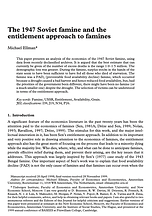
Title: The 1947 Soviet famine and the entitlement approach to famines
Author: Michael Ellman
Place of publication: United Kingdom, Oxford
Year: 2000
Language: English
Abstract: This paper presents an analysis of the economics of the 1947 Soviet famine, using data from recently declassified archives. It is argued that the best estimate that can currently be given of the number of excess deaths in the range 1.0-1.5 million. The demographic loss was greater. During the famine, surplus stocks in the hands of the state seem to have been sufficient to have fed all those who died of starvation. The famine was a FAD2 (preventable food availability decline) famine, which occurred because a drought caused a bad harvest and hence reduced food availability, but, had the priorities of the government been different, there might have been no famine (or a much smaller one) despite the drought. The selection of victims can be understood in terms of the entitlement approach.
1946-1947

Title: Historiography of the Famine of 1946–1947 in Ukraine International Scientific Congress of Ukrainian Historians “Ukrainian Historical Science on the Path of Creative Progress”
Author: Oleksandra Veselova
Place of publication: Ukraine, Lutsk
Year: 2006
Language: Ukrainian
1946-1947
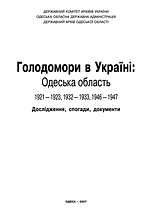
Title: Holodomors in Ukraine: Odesa Region, 1921–1923, 1932–1933, 1946–1947. Research, Memoirs, Documents.
Place of publication: Ukraine, Odesa
Year: 2007
Language: Ukrainian
ISBN 978-966-318-816-4
1921-1923
1946-1947

Title: Famine of 1946-1947 in Southern Bessarabia: Artsyz District of Odessa Oblast
Author: Konstantin Pelivan
Place of publication: Ukraine, Artsyz
Year: 2008
Language: Russian
ISBN 978-966-96509-7-9
1946-1947
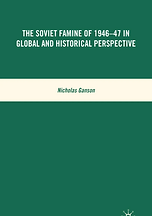
Title: The Soviet famine of 1946-47 in global and historical perspective
Author: Nicholas Ganson
Place of publication: USA, New York
Year: 2009
Language: English
Abstract: This book illuminates a little-known but tremendously significant twentieth-century crisis in the Soviet Union. Drawing on archival materials declassified since the fall of communism, Nicholas Ganson situates the famine of 1946-47 at the crossroads of Soviet social and political history, World War II, the Cold War, ideology, and famine in the modern world. He sheds light on the perspectives of Soviet elites and gives voice to the famine s victims. In revealing the multi-causality of the postwar hunger, this ambitious work challenges the received wisdom about the relationship between politics and famine.
Table of Contents:
Tracing the roots of the failed 1946 harvest
Exploring the causes of child mortality
Food shortages and ration reforms in the towns and cities: Moscow and beyond
None dare call it resistance?: coping, opposition, and the Soviet state
The famine, the dawn of the Cold War, and the politics of food
The Soviet famine of 1946-47 in the context of Russian history
Placing the famine of 1946-47 in global context.
1946-1947
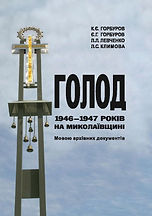
Title: The Famine of 1946–1947 in Mykolaiv Region: Through the Language of Archival Documents
Authors: K.E. Gorburov, E.G. Gorburov, L.L. Levchenko, L.S. Klimova
Place of publication: Ukraine, Mykolaiv
Year: 2010
Language: Ukrainian
ISBN 976-966-8442-66-7
Abstract: This publication provides a comprehensive overview of the historiography of the subject and a survey of historical sources related to the post-war famine of 1946–1947 in the Mykolaiv region.
The book introduces 167 archival documents into scholarly circulation, the majority of which had not been studied by researchers for decades. Their further use will enable scholars to conduct an objective investigation of the causes, tragic course, and economic and demographic consequences of the famine.
For the first time, the administrative-territorial division of Mykolaiv Oblast as of September 1, 1946 is presented.
The book is intended for scholars in the humanities, politicians, educators, local historians, university students, senior school students, and all readers interested in the history of Ukraine and the Mykolaiv region.
1946-1947
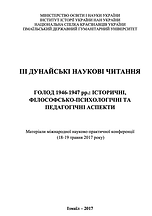
Title: III Danube Scientific Readings“The Famine of 1946–1947: Historical, Philosophical-Psychological, and Pedagogical Aspects”
Place of publication: Ukraine, Izmail
Year: 2017
Language: Ukrainian
1946-1947

Title: PROJECTION OF A METAMODERN METHOD FOR THE STUDY OF THE FAMINE IN BESSARABIA IN 1946–1947, REFLECTED IN HISTORICAL PAINTING
Author: Yona Tukuser
Place of publication: Bulgaria, Sofia
Year: 2020
Language: Bulgarian
ISSN 0323-9748
Abstract: The article uses a metamodern method of research with scientific and artistic techniques, which serves as a basis for the connection between science and fine arts. The results of the study of literature on the subject and newly discovered documentary sources are used to recreate the famine in Bessarabia in 1946–1947 in picturesque historical paintings. Visual images reveal the influence of the tragic consequences of the famine and support the understanding of the socio-cultural and moral-psychological state of the Bessarabian Bulgarians. The emotional artistic expression in the paintings is a means of deep penetration into the atmosphere of abuse of human dignity in Bessarabia, through purposefully provoked hunger.
1946-1947
Title: The Soviet Famine of 1946–1947, the Weather and Human Agency in Historical Perspective
Author: STEPHEN G. WHEATCROFT
Place of publication: England, Europe-Asia Studies
Published By: Taylor & Francis
Year: 2012
Language: English
Abstract: This article considers the famine of the immediate post-war period of 1946–1947 in relation to the food problems experienced by the USSR in World War II and to the impact of the weather conditions from 1941. It is argued that the timing and nature of the extreme food problems experienced in this famine conform to a general pattern of Soviet famines in which urban food supply problems over a number of years give rise to increasing pressure on the peasantry and a general reduction of stocks, which when complicated by drought and harvest failure produces a rural famine.
1946-1947

Title: Famine in Ukraine in the First Half of the 20th Century: Causes and Consequences (1921–1923, 1932–1933, 1946–1947)
Proceedings of the International Scientific Conference
Place of publication: Ukraine, Kyiv
Year: 2013
Language: Ukrainian
ISBN 978-966-02-7025-1
Abstract: This collection presents the proceedings of a conference at which, for the first time, a comprehensive examination was made of the three most devastating famines that affected Ukrainian society during the first half of the twentieth century.
The first part examines the general picture of the famines and their territorial characteristics, providing a comprehensive understanding of the course and development of these tragic events.
The second part focuses on the legal qualification of the Holodomor of 1932–1933 in Ukraine as genocide.
The third part is devoted to methodological approaches for identifying and assessing demographic losses caused by the famines, including their differentiation across various regions.
The final, fourth part brings together studies examining the socio-psychological consequences of the famines for Ukrainian society.
The publication is intended for researchers, educators, students, and all those interested in the history of famine in Ukraine and concerned about the future of their country.
1921-1923
1946-1947

Title: Folk Works on the Holodomor: 1921–1923, 1932–1933, and 1946–1947 in Ukraine, сollected by Philology Students of Kryvyi Rih State Pedagogical University in the Late Twentieth and Early Twenty-First Centuries
Place of publication: Ukraine, Kryvyi Rih
Year: 2011
Language: Ukrainian
Abstract: This collection comprises folklore works about the Holodomor gathered by philology students of Kryvyi Rih State Pedagogical University during their fieldwork in eleven central, western, and southern regions of Ukraine in the late twentieth and early twenty-first centuries.
The volume includes oral narratives, memoirs, legends, humorous folk verses, a lullaby, and a duma (traditional Ukrainian epic folk ballad) that reflect the consequences of the tragic history of the genocide of Ukrainians during the three Soviet famines of 1921–1923, 1932–1933, and 1946–1947. The collected materials also document the impact of mass requisitions, the plundering of peasant households, excessive grain procurement campaigns, dekulakization, forced collectivization, industrialization, and the national extermination policy carried out under Stalin's regime.
The introduction and the brief essays preceding each section examine the psychological, philosophical, and historical origins of folk creativity related to the Holodomor. They also discuss the development of Ukrainian folklore studies during the 1920s to 1940s and explain the historical evolution and distinctive characteristics of the genres represented in the collection.
The volume additionally includes folkloristic studies by D. T. Fedorenko and V. M. Skrypka, who were directly involved in collecting folklore about the Holodomor in the Middle Dnipro (Prydniprovia) region. During their teaching careers at Kryvyi Rih State Pedagogical Institute in the 1980s and 1990s, they also engaged students in this important work of documenting oral tradition.
1921-1923
1946-1947

Title: Russia After the War.
Hopes, Illusions and Disappointments, 1945-1957
Author: Elena Zubkova
Place of publication: England
Year: 1998
Language: English
ISBN 9780765602282
Abstract: The years of late Stalinism are one of the murkiest periods in Soviet history, best known to us through the voices of Ehrenburg, Khrushchev and Solzhenitsyn. This is a sweeping history of Russia from the end of the war to the Thaw by one of Russia's respected younger historians. Drawing on the resources of newly opened archives as well as the recent outpouring of published diaries and memoirs, Elena Zubkova presents a richly detailed portrayal of the basic conditions of people's lives in Soviet Russia from 1945 to 1957. She brings out the dynamics of postwar popular expectations and the cultural stirrings set in motion by the wartime experience versus the regime's determination to reassert command over territories and populations and the mechanisms of repression. Her interpretation of the period establishes the context for the liberalizing and reformist impulses that surfaced in the post-Stalin succession struggle, characterizing what would be the formative period for a future generation of leaders: Gorbachev, Yeltsin and their contemporaries.
Table of Contents
Part 1 Survival Strategy: The Social-Psychological Impact of the War; Victory and the Victors; "What Will Life be Like After the War?" - Expectation vs. Reality; Hungry Years - Popular Methods During the Famine of 1946-47;
1946-1947

Title: Famine in Ukraine in the First Half of the Twentieth Century: Causes and Consequences (1921–1923, 1932–1933, 1946–1947)
Proceedings of the International Scientific Conference
Place of publication: Ukraine, Kyiv
Year: 2013
Language: Ukrainian
Abstract: This volume contains the proceedings of the International Scientific Conference, which, for the first time, offered a comprehensive examination of the three most devastating famines that affected Ukrainian society during the first half of the twentieth century.
The first part presents an overview of the famines and their regional characteristics, providing a comprehensive picture of the course and geographical dimensions of these tragic events.
The second part is devoted to the legal qualification of the Holodomor of 1932–1933 in Ukraine as genocide.
The third part examines methodological approaches to identifying and estimating the demographic losses caused by the famines, including their regional differentiation.
The fourth and final part brings together studies investigating the social and psychological consequences of the famines for Ukrainian society.
This publication is intended for researchers, university lecturers, students, and all readers interested in the history of famine in Ukraine and concerned about the future of their country.
1946-1947

Title: The Holodomor in Sumy Region in Eyewitness Accounts: Collection of Materials. Volume 1
Place of publication: Ukraine, Sumy
Year: 2008
Language: Ukrainian
ISBN: 978-966-7222-78-9
Abstract: This volume contains eyewitness testimonies of the Holodomors of 1932–1933 and 1946–1947 in the Sumy region, collected by school pupils, university students, and their teachers as part of the project "The Holodomor in the People's Memory."
The publication preserves personal memories of survivors and witnesses, making an important contribution to the documentation and preservation of Ukraine's oral historical heritage.
1946-1947

Title: The Holodomor in Sumy Region in Eyewitness Accounts: Collection of Materials. Volume 2
Place of publication: Ukraine, Sumy
Year: 2008
Language: Ukrainian
ISBN: 978-966-7222-78-9
Abstract: This volume contains eyewitness testimonies of the Holodomors of 1932–1933 and 1946–1947 in the Sumy region, collected by school pupils, university students, and their teachers as part of the project "The Holodomor in the People's Memory."
The publication preserves personal memories of survivors and witnesses, making an important contribution to the documentation and preservation of Ukraine's oral historical heritage.
1946-1947

Title: The Ukrainian SSR: Administrative-Territorial Division as of September 1, 1946
Author: Edited by M. F. Popivskyi
Place of publication: Ukraine, Kyiv
Year: 1947
Language: Ukrainian
1946-1947